In an even more violent break
from democratic theory than exemplified in
my last couple of “Eastern Philosophy” entries (a practice I will almost certainly
not continue–at least not very often–in the new year!), I decided to put together a
seasonal “philosophy of life” piece containing positions found in the work of two
prominent religious figures that I (a distinctly non-religious person) happen to
find congenial. Whether this amalgamation should be considered an actual “philosophy” or is just a pastiche will, of course, be a matter of opinion. I hope, though, that it at least manages to be internally
consistent in spite of its being little more than a concatenation of portions of
Ecclesiastes (purged of all God talk and its own internal contradictions)
and Buddhism (purged of all talk of Karma, rebirth and emptiness, and utilizing a simplified concept of Dependent Origination).
Even without making any attempt to produce a decent case for the view outlined here, this project seemed a lot to manage without significant
research. Clearly, it would take a ton of time and trouble if I had to do it on my own. Having no ready human collaborators available,
I called upon the vast computing power of ChatAI for help.† And with the assistance of that behemoth, I was able to
fabricate the Frankenstein monster found below in about a week.
In addition to consistency, I hope our result manages a decent level of coherence, for it must be acknowledged that the two thinkers being thrown together here have only rarely been thought of as compatriots over the last couple of millennia. Of course, it's a lot easier to fit two world pictures comfortably
together if the puzzle-solver is allowed to alter or truncate pieces wherever
it is convenient to do so; and that is what ChatAI and I have done. But, in spite of the liberties that my digital assistant and I have taken on that front, I believe a number
of contemporary Buddha and Qoheleth devotees may find our goulash
agreeable. In any event, ignoring Buddhist warnings about the dangers of fabricating,
what follows is our concoction.
Among the most basic Buddhist injunction is that each seeker should engage in a quest (though without craving!) for equanimity. And that aspiration must take precedence over
any such activities as hating, mourning, killing, dancing, laughing
or casting stones–all the sorts of behaviors the author of Ecclesiastes says
(so eloquently) that there “is a time for.” Perhaps, Qoheleth's admonition that
these activities should take place only in their appropriate times handles that
peril. It may also be, however, that it's not only particular times that are required
for the various activities, but also particular ways of weeping, laughing
and the rest.
There are other tensions between
the writings of these two sages too. But however stark the differences between these texts may be claimed
to be, it should be obvious that there are a number of similarities as well. Consider,
e.g., “The labor of the wise enriches them, but the foolish only exhaust themselves"
(Ecclesiastes 10:15 CSB). This suggests that toil can bring fulfillment/enrichment,
only so long as it is approached with wisdom and understanding. That sort of “mindfulness-in-action”
is, of course, a staple of Buddhist thought.
Again, "He who loves money
will not be satisfied with money, nor he who loves abundance with its income. This
also is vanity" (5:10). This passage will surely remind many of the Buddhist
principle that excessive craving for material possessions or wealth can never
satisfy; indeed, it can lead only to frustration and disappointment.
It may seem that even Qoheleth
is of more than one mind regarding our labors, claiming both their value and
that they are all “vanity and vexation of spirit.” I think, though, this apparent
contradiction is handled by realizing that when Qoheleth instructs us to take pleasure
from “our works” at the same time he accuses nearly everything “under the sun” of being little more than vanity, he means that we should enjoy the labors themselves, whatever may be derived from their products. It cannot be denied though, that in addition to seeing labor itself as a fitting object of personal satisfaction, Qoheleth sometimes seems quite confident that no harm comes
from enjoyment of such fruits of our work as wealth, success, or wisdom, so long as this gratification
is taken in moderation and without excessive pride. He seems to say that when we
partake of such goods, we must simultaneously remember that our lives are quite short and we can never know much about the mysteries of the universe or where it’s ultimately
taking us. Some of us may be more prone to folly than others, but the basic, essential
limits of human knowledge are largely unaffected by how rich, famous, or “wise” this
or that thinker is or might become. We are all infinitesimal creatures.
In any case, hard work and productivity
are claimed to be importantly valuable aspects of life if considered in the appropriate light and enjoyed
in the appropriate manner. The theory, somewhat similar to that urged upon Arjuna by Krishna
on the battlefield, is that engaging in honest labor provides its own satisfaction regardless of one's station, and those benefits may be obtained without necessitating the acquisition of any harmful attachments. Our
toil may also contribute valuable distractions from our inescapable and universal
fate; distractions which, if handled correctly, contain no toxins. In sum, Qoheleth may be understood to say that if we are careful to do so in a manner that avoids craving and clinging,
enjoying food, drink, and other simple pleasures will contribute to happy and fulfilling
lives. A Buddhist might put it that, to be safe, such pleasures must always be sought
and ultimately enjoyed with mindfulness, and should be consequent only upon a meditation-engendered
understanding of appropriate and inappropriate desires, based not only on their
objects, but also their nature and intensity.
The Buddha agrees with Qoheleth
that the quest for any sort of enjoyment must be of a particular, moderate sort: "Those who are slaves to craving go round
and round in samsara, bound by their… thoughts of 'I' and 'mine'" (Sutta
Nipata 713). This emphasis on the dangers
of clinging and attachment, and their tendency to keep us trapped in a cycle of
suffering and dissatisfaction can be found throughout the Suttas. Here is another
example: "Bhikkhus, the craving of a person who is not free from craving for
sensual pleasures is like the hunger of a person who has not eaten for a week. Bhikkhus,
the craving of a person who is not free from craving for becoming is like the hunger
of a person who has not eaten for a month. Bhikkhus, the craving of a person who
is not free from craving for not-becoming is like the hunger of a person who has
not eaten for a year" (Sutta Nipata 714). This is a key element of Buddhist thinking: cravings and attachments all
eventually become all-consuming. They must therefore be understood to be absolutely
destructive to well-being. And in addition to the dangers of attachments, the Buddha
also warns of harms necessarily attendant upon excessive anger, aversion, jealousy,
resentment, hate, etc.
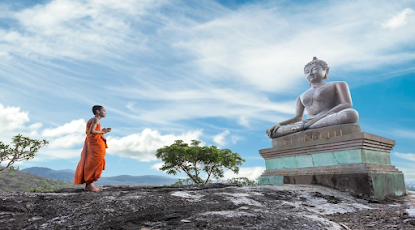
Not an entirely melancholic
religion, Buddhism provides an antidote to this predicament in its teaching of Dependent
Origination. This law of universal causation is thought to provide a way to prevent the acquisition of a wanted
good–or the resentment, jealousy or disappointment ensuing from a failure to obtain
it–from leading one into addiction, depression or withdrawal. According to the theory, the solution to omnipresent suffering starts with the recognition that every event and individual object in the world
arises in dependence on other factors as well as causal laws. This means that no state
of affairs or thing exists independently or in isolation from prior and concurrent
causes and conditions, but each is instead interconnected with and dependent on
other states and things for both its existence and its particular characteristics.
As we have little control over most of the relevant prior conditions that affect us,
we should infer that we have quite limited control over our fates–except as they
are a function of acceptance/resistance of what happens to confront us.
But why is there claimed to
be this crucial difference between our control over what happens to us and our subsequent
reactions? Isn’t all of it beyond our ability to change? The Buddhist idea
seems to be that we retain a portion of autonomy in spite of the universality of
Dependent Origination. How is this possible? In attempting an exit from this maze, I think it is helpful to begin by recognizing that various
wildly different species of “cause” pop up in the many specifications of Dependent Origination found in the Suttas,* and to proceed we must first excise from the theory all supposed
elements that are not clear examples of efficient
causation (an event X bringing about event Y, the way a shove may bring about someone's fall).
This simplification is important because, e.g., it is odd to call oxygen (or, say, the shape of the Earth) “the cause–or even a cause–of one of Shakespeare’s
sonnets or of Argentina’s recent victory in the World Cup Final. Without the removal
of several of the types of elements commonly included in the Dependent Origination theory, we will be left with just such misleading anomalies. To say, for example that John's misstep was "caused by ignorance" is bound to lead to the same sort of confusion. However, after we complete a filtering intended to leave only such
items as can be reasonably claimed to be efficient causes, we will see that that even
the remaining (billiard-ball-hitting-type) events are not by themselves sufficient to do the work proposed of them: each is still only a necessary predecessor that cannot make anything happen without help.
How does this lack of sufficiency
provide an escape from utter powerlessness? Consider just these causal event
types that remain in our modified version of Dependent Origination: ".....From contact [through one of the
six sense media] as a requisite condition comes feeling. From feeling as a requisite
condition comes craving. From craving as a requisite condition comes clinging/sustenance.
From clinging/sustenance as a requisite come….sorrow, lamentation, pain, distress,
& despair." (Samyutta Nikaya 12.2). Arguably, we have examples only of
efficient causes now: a particular perceptual experience causes a particular feeling, etc. But it remains the case that more seems to be required to ensure the
emergence of any particular consequence that is specified. The Buddhist idea is that human beings can prevent
the addition of some of these required “extras.” We can, that is, simply stop
the process between a percept and particular sort of feeling or between dangerous
types of feeling and the emergence of cravings.⟡ For according to Buddhist doctrine, we can learn to dissociate our sense perceptions
from ensuing incidences of either pleasure or pain.⸋ Thus, from sense-content no particular feeling need arise, and even if we cannot stop things there, craving and the rest
need not inexorably follow. That, in a word, is the
power to stop new addictions and overcome old ones. In the same way, aversions and
other negative responses can be avoided. This ability is thought to be the key to overcoming dukkha, the existential suffering that may seem to be irrevocably attached
to human existence.
There thus seems no problem
with taking Qohelethian, tempered enjoyment in simple pleasures: those who partake in that fashion need not become overly attached to anything as a result. No more, certainly than will be associated with minimal nutritional sustenance. Gaining this ability would seem to allow us to live more balanced
and less ascetic or guilt-ridden lives. Our goals must always be sensible ones however, and our strivings to reach every one of them them restrained. A recognition of the interdependence of all living beings may
also encourage the cultivation of a sense of compassion for others and help us overcome resentment and jealousy. It may be that to reach our goal of equanimity we will
need to walk some distance along the Buddha’s Eightfold Path of right speech, right thinking, right livelihood and the rest, but we need not follow
it down any turning where it disallows such activities as laughing, weeping, dancing,
eating, drinking or mourning; perhaps even hating and killing can be allowed when
and where there is good cause and these activities are undertaken without excessive
malice.
It can be seen that recognizing
the truth of Dependent Origination must involve accepting the limits of our ability
to control our destinies or understand what will happen to us after we
die. It also seems to entail that wishing and petitionary prayer are not only a waste of
time, but may actually be pernicious, both because they are inconsistent with an
understanding of the causal constraints on everything in the known world, and because
they may be expressions of unhealthy types of desire. By acknowledging the uncertainty and
impermanence of life, we can let go of such attachments and live in the present
moment with a sense of peace and contentment. Again, however, we must maintain only
sensible goals and be willing to work at achieving them, rather than spend our
time wishing or praying.
So far, so good. But where both
sages seem to me to err is in their failure to recognize that claims about such
matters as God, rebirth, “self,” essences, nirvana, and karma are not the
sorts of things that can ever be substantiated. For these are, as philosophers say
nowadays, “heavyweight” matters. All such
assertions go beyond what any person–or even any scientific investigations–can confirm.
Being metaphysical queries, obtaining definitive, universally satisfying answers to them would require an
ability to go outside all "conceptual schemes" or "categories" produced by our upbringings, language, philosophical training, individual temperaments etc. We are, in the words of Everett Hall all ensconced in what he called "categorio-centric predicaments" from which no one can escape. So, for good or ill, deep wisdom of the ontological (What is there in the world?) or axiological (What are the right things to be done?) kinds is simply impossible for homo sapiens.#
No doubt both Gautama Siddhartha
and Qoheleth are usually considered religious figures rather than philosophers, and
their works may be counted as “wisdom literature.” Their readers and admirers may therefore not care too much about my concerns with respect to epistemic limitations. However that may be, I hope a feasible course of action for the troubled among us who are uncomfortable
with religion will have begun to come into view. For it seems to me possible to find a humbler, more judicious place to rest in the works of these two thinkers, a plateau where even a skeptic might find comfort.
It is interesting that both
the Buddha and Qoheleth sometimes speak as though they understand and accept the
limits of rational thought, but at others clearly forget these constraints and make
claims that cannot be justified without revelation. Ecclesiastes contains
occasional God-assumptions that should be considered inconsistent with rational limits:
"[W]ho can tell someone what will happen after he is gone? (10:14) and “I applied
my heart to know wisdom and to know madness and folly. I perceived that this also
is but a striving after the wind….He who increases knowledge increases sorrow."
(1:16-18) And for his part the Buddha famously
upbraids those of his monks who pestered him with what he considered to be pointless philosophical queries
by reminding them that he had never promised to "...elucidate to you either
that the world is eternal, or that the world is not eternal, or that the saint neither
exists or does not exist after death." And he tells them that "The religious life
does not depend on the dogma that the world is eternal; nor does the religious life
depend on the dogma that the world is not eternal. Whether the dogma obtain that the world is eternal,
or that the world is not eternal, there still remain birth, old age, death, sorrow,
lamentation, misery, grief, and despair, for the extinction of which in the present
life I am prescribing. The religious life
does not depend on the dogma that the world is finite. The religious life does not
depend on the dogma that the soul and the body are identical. The religious life
does not depend on the dogma that the saint both exists and does not exist after
death; nor does the religious life depend on the dogma that the saint neither exists
nor does not exist after death." He explains why the religious life fails to involve
expounding on such matters: "Because this profits not, nor has to do with the fundamentals
of religion nor tends to aversion, absence of passion, cessation, quiescence, the
supernatural faculties, supreme wisdom, and Nirvana; therefore I have not elucidated
it." (Majjhima Nikaya 63)
Now, it may be objected that
despite my own assurances to the contrary, there is metaphysics aplenty in any claim
that we can somehow exempt ourselves from causal laws by dissociating various perceptual
experiences from pleasure, pain, craving, or aversion. In response, let me first
say that I make no pretense of eschewing metaphysics entirely. To the extent that
I assume the existence of people, causes, aging, individual suffering, death, and the like, I adopt a
common-sense worldview that cannot be strictly demonstrated to be veridical. But as to the specific
objection regarding allegedly sneaking out of the jaws of Dependent Origination in order to capture some sort of “equanimity” for those practicing “right meditation,”
I insist that I am relying on empiricism only. I suggest simply that one may try
and see, and I note that, at the very least, many throughout history have claimed success in their
own searches for equanimity and peace by the use of the proffered techniques. I abjure from speculations about what may be beyond what we can experience for oneselves, and I propose no general
theories involving free will or determinism.$
In summary, the patchwork philosophy
of life concocted here with the help of my computerized assistant out of various
tenets of Qoheleth and the Buddha acknowledges the depth and inescapability of human ignorance,
emphasizes the importance of hard work/productivity, and, eschewing even partial asceticism, confers value upon simple
pleasures. However, success in achieving
a happy and fulfilling life is argued also to generally require diligent
mindfulness, whatever may be one’s luck (or lack of it) “under the sun.” The good
news is that, no matter the level of success, wealth, or wisdom we may happen to achieve--whether by luck or cunning-- we can, by aspiring for equanimity and practicing
moderation and mindfulness (even in that quest!) overcome harmful craving and unhealthy attachments and come to live in the present moment with a sense of peace. Reaching
a state of such contentment may require an understanding and acceptance of
Dependent Origination in something like the form elucidated here, and there is little doubt that such understanding is useful in this sort of quest. But, however the case may be with respect
to propositional knowledge of the workings of causation in human affairs, it is clear that one must learn how to carry out certain dissociative techniques in
accordance with the precepts of this theory. The balanced approach to life set forth
herein can help practitioners find both fulfillment and calm–as well as relief from
guilt–even in the face of both pervasive constraints on our autonomy and the apparently ineliminable uncertainty attached to every single philosophically "heavyweight" proposition that can be asserted, whether factual or moral.
**************************************
† For a brief and fairly breezy explanation
of the background for and mechanics of my collaboration with ChatAI, see my new
essay in Erraticus.
* So, for example, ignorance
is not the sort of thing that can be an efficient cause, however it may be thought
to function in “producing” our (defective) understandings of the world. Nor should
“name-and-form” be thought
to be an efficient cause, even if it’s true that we could have no concept of causation without its operation. Finally, neither birth, nor aging and
death seem to me appropriately placed in customary statements of Dependent Origination.
⟡ Techniques
for throwing a wrench into this machine can be found in Buddhadasa, Under the
Bodhi Tree (2017) and Leigh Brasington, Dependent Origination and Emptiness
(2021). It is important to understand, however, that neither of those authors–unorthodox
as they may be considered by some traditionalists–would ever suggest making amendments to Buddhist doctrine.
When they differ from other, more orthodox Buddhologists, they simply insist that interpretations contrary to their own exhibit misunderstandings of the Suttas. My skeptical bent (and,
perhaps, excessive hubris?) has made me quite comfortable with changing or deleting
any tenet that seems indefensible--or even inadequately supported.
⸋ For arguments in support of the possibility of these perhaps unintuitive
claims, see Richard Hall, “Are Pains Necessarily Unpleasant?” (1989).
# This notion is explained and
defended by Everett Hall’s (Richard's father!) in his Philosophical Systems: A Categorial Analysis (1960).
I have written extensively on this subject--and Hall’s work generally--in my The Roots of
Representationism: An Introduction to Everett Hall (2013).
$ I talk in some detail about
various types of meditation and the practical effects they can have on one’s life
in my The Perennial Solution Center (2003).