Friday, January 5, 2024

Disinformation and the Seductiveness of Wonder


In 1960, William Newcomb, a physicist at the Lawrence Livermore Laboratory, concocted what might be called a greed paradox. He asked people to imagine a game in which players are presented with two boxes. One of them is transparent and always has $1000 visibly inside it, while the other is opaque and contains either a cool million bucks or nothing at all. Players have the choice of taking both boxes or only the opaque one, and either way they get to keep all the money in the box or boxes that they choose. A simple, yet always remunerative game.

Newcomb’s rules prescribe that every participant has the following absolutely reliable information:

1.    Whoever puts the money in the boxes is a prognosticator. If she predicts the next player will take only the million-dollar box, she will always put the money in there. If she expects the player to take both boxes, she will never put even a dime in the opaque box.

2.    This prognosticator has always been correct. Historically, every prior player who has taken both boxes has gone home only with the paltry grand. But those who pick just the opaque box leave rich. (Keep in mind that a million bucks was a very tidy sum in 1960).

3.    There is no jiggery-pokery of any kind. The predictor never cheats, for example by somehow sneaking money in or out of the million-dollar box after hearing a choice made. The money is either in there or it isn’t prior to the announcement of a participant’s decision, and no change is made afterwards. There’s neither any fancy technology nor any old-fashioned legerdemain in play: just incredible predictive accuracy.

The literature suggests that there are generally two diametrically opposed attitudes maintained by those who consider Newcomb’s brainchild. The logical, apparently scientific sort can always be expected to take both boxes. I can almost hear one such scholar pleading, “How can it ever make sense not to take both? The money is either in the second box or it isn’t; my choice can’t affect the outcome. Obviously, we should take all the money being offered rather than settle for only a portion of it!”

But the pragmatist will be more interested in past results than in such scientific truisms. She wants to join the millionaire club and may not care so much (at least not while playing) about how the historical results are even credible. She’s been assured both of the uniformity of the past outcomes and of the integrity of those running the game. Concerns regarding how such apparently baffling results have occurred will seem to her purely academic. It may be mystifying that the choice to take all the money on the table is never as financially rewarding as just opting for some of it, but this may pale before her employer’s warnings about possible upcoming layoffs and her recognition that mortgage payments will continue to be required by her bank until hell freezes over.

Now, one might think that this entire debate is purely academic and doesn’t much matter in the real world. Presumably, after writing up his intriguing little paradox, Professor Newcomb went back to his radiation studies and then maybe listened to a radio show about why the California Democratic Delegation chose not to support JFK at the 1960 National Convention; or maybe he just caught a movie. After all, even if his thought experiment was cool, the real world doesn’t actually contain games where causality goes on holiday like that. Maybe Pascal’s Wager, according to which it’s silly not to believe in God once you consider the incredible benefits promised to the devout, had long been touted as a good reason for theism, but like million dollar promises, that pie has also always been in the sky. Going along with something just because doing so gives you a kind of wonderful glow, is naïve, nothing but a sucker’s game.


But what about when naivety seems to make good sense? For it seems to do so, at least in the area of medicine. Not long ago, a neighbor of mine whose entire family had just gotten over bouts of COVID, told me that her doctor had prescribed ivermectin to each of them.

“Well,” I quipped, “it certainly seems to do its job in keeping my dog free of heartworms.”

“Oh,” she shot back with a visible eye-roll, “the human dosage is very different. Anyhow, that drug was a game-changer for us.”

In the area of human health—in fact, human well-being generally—the benefits of “going along with a trusting heart” has been well known at least since Henry K. Beecher’s 1955 publication of “The Powerful Placebo” in The Journal of the American Medical Association. Beecher’s article described the first clinical studies of something care-givers had known for centuries: sometimes the only causal connection that is necessary for improvement of physical symptoms seems to be faith in the healthcare provider. Here, too, one can take the same tack as those who paradoxically eschew the second box based on nothing but the guarantee of an ostensibly sage prognosticator. Given the power of “wisdom” (real or imagined) it’s no surprise that items with exotic names like ivermectin and hydroxychloroquine took off as plausible COVID remedies while the more mundane recommendations of bleach and internal lights were, if not always scorned, at least almost universally ignored. Sufferers want something that at least sounds like science—pseudo or otherwise. And a number of studies[1] indicate that we can again find two different sorts of participants in the game who will obtain differing levels of success: the skeptics and the arguably more credulous pragmatists.

Now it’s important to distinguish this effect from what happens in a traditional con, where there’s no overall or long-term benefit for the “rube” because all the real goodies go to the sophisticate running the game. Being “fooled” is a different matter in the area of one’s health. Just as it seems eminently sensible to choose to become an instantaneous fat cat rather than retain a foolish pride in one’s high level of “scientific consistency,” it also seems obviously better for a sick person to grab an opportunity for a quick and easy return to health rather than worry overmuch about what “Big Pharma” can or can’t prove to the satisfaction of a bunch of government bureaucrats (who, after all, may just be pointy-headed know-it-alls or useless patronage hires). The point is that this formerly maligned “gullibility” can reasonably be claimed to be valuable across more domains than have been regularly recognized—and thus, a perfectly sensible approach. And while it’s possible that a bad actor might profit from a bit of hyperbole, those winnings might be swamped by benefits either to the alleged “greenhorn” or to the community at large. So, it’s a mistake to treat my neighbor’s choice as analogous to a Ponzi scheme being perpetrated on an unsuspecting lamb.


Consider a few other areas where this sort of effect can be seen. First, the movies. Perhaps many of us can recall the reaction they had upon first learning that the movie Fargo (1996) wasn’t really based on actual murders in North Dakota, as is stoutly claimed in its opening moments.[2] Director Joel Coen’s thinking was clearly that the film would be more effective if it proclaimed that it was based on events that really occurred. He likely thought, “Hey, it’s a movie, and movies are allowed to be fictional, so it doesn’t matter whether it’s true when this particular one claims it isn’t fiction.” I myself felt a sort of betrayal when I found out about that move, but it was wedded to a kind of vertigo, because I couldn’t deny that Coen was right. The movie really was more effective because I bought the lie that it was a docudrama. So the disinformation didn’t just benefit the movie-makers. And, many will ask, what’s the harm? If anyone is terribly interested, they can just look it up and they’ll find out exactly how much actual truth there was in Coen’s grisly story. If it turns out that there was even less than found in the Hollywood telling of Butch Cassidy’s life, so what? Maybe the truth-stretching film makes more money, but that’s because moviegoers have benefited from increased astonishment. Who is hurt?


Next, consider a modest institution which, since its founding in 1988, has been considered a paragon of harmless wonder generation via its clever use of “the little white lie.” I’m referring to an odd storefront attraction just northwest of the Culver City section of Los Angeles called “The Museum of Jurassic Technology.” If the place remains a bit too eccentric to categorize even after a visit or two, an engaging book[3] by Lawrence Wechsler about the museum and its brilliant originator and continuing curator, David Wilson, may help. Wechsler seems to start out sharing my bewilderment at Wilson’s systematic doling out of cloudy but convincing half-truths, but he ends up lionizing the exhibitor for his appreciation and effective use of wonder. Among Wilson’s most baffling creations are a couple of quite believable but entirely fabricated pseudo-scientists. One, called Geoffrey Sonnabend, is supposed to have written a three-volume tome on the mechanism of memory while he was a faculty member at Northwestern University in the 1940s. Sonnabend’s “plane-and-cone theory of obliscence” doesn’t seem that crazy once one spends a bit of time deciphering the framed diagrammatic models on the museum wall, and even if it is a bit cuckoo, lots of weird hypotheses have been proposed over the years by quack “scientists”—especially those focusing on “the mind.” Both Sonnabend’s speculations and his personal history are admittedly vague and quite bizarre, but how much midcentury American neurophysiology is a casual museum visitor supposed to have at her fingertips? And what is unreasonable to imagine about the effects scholarly obsessions might have on a sensitive, middle-aged psychologist? After all, Sonnabend (in common with the absolutely non-fictional German scientist, Gustave Fechner, by the way) was said to have suffered a severe nervous breakdown prior to coming up with his off-kilter theory. And isn’t our faculty of memory mysterious by its very nature? I mean, what, exactly is “the past,” anyhow? If it doesn’t exist anymore, how can we manage to have access to it? If facts are weird, why can’t they have equally weird explanations and explainers?

Wilson’s museum is piled high with such stuff—much of it poorly lit and purposely askew. One exhibit may cause us to reflect that, while we are quite sure that the breath of a duck has never cured a single human ailment of any kind, we aren’t quite so certain that no now-crumbling witchcraft book (maybe a Bulgarian one?) ever suggested the effectiveness of such a cure. Is Wilson’s duck breath display approvably “historical” if what it claims can be found in a suitably old or exotic book? Is it enough that some person or group did once believe in the duck breath cure? If the bogus Professor Sonnabend is a sufficiently reasonable facsimile of actual pseudo-scientists to make for a legitimate museum exhibit, maybe it’s also enough that some person or group might have believed (in the now “obliscent” past) that the breath of a duck was curative for ague or quinsy. So why fight the delicious experience enabled by our ingenuousness, no matter how naïve it makes us seem? Who is the buzz-kill who would fault anyone merely for exhibiting a childlike innocence?

Wechsler quotes Einstein’s remark that “The most beautiful experience we can have is the mysterious….Whoever does not know it can no longer wonder, no longer marvel, is as good as dead, and his eyes are dimmed.”[4] Wechsler adds that Wilson’s attitude seems to be that the “delicious confusion” produced by a visit to the Museum of Jurassic Technology “may constitute the most blessedly wonderful thing about being human” (p. 51).

Well, I can’t deny that the place is a kick. But is there really no societal cost at all associated with shrouding the very idea of truth in an everlasting ambiguity? Everyone knows that cheap and widespread dissemination of what is now widely called “disinformation” is available nearly everywhere today, and this fact is seen by some as being an existential danger to civil society.


It certainly can’t be disputed that a lot of new work on disinformation is currently being published. In fact, I’ve reviewed a few books on that matter myself.[5] One recent one I had been intending to write something about caused me to think more about a possible connection between the accommodation of an (apparently innocent) wonder and the known dangers of “fake news.” It was the late David Graeber’s final published work, Pirate Enlightenment, or the Real Libertalia. Graeber was an anthropologist, but is probably at least as well known for being a firebrand anarchist, and as I began to read, I realized that the book was at least as much activism as it was anthropology. My interest in this work centered on the author’s claims about the effects on enlightenment thinking produced by certain democratic experiments allegedly taking place in several early 18th Century pirate kingdoms in Madagascar. But it wasn’t long before I began to suspect that a significant portion of Graeber’s history was based on wishful thinking. His goal was to credit such “great utopian experiments” as Libertalia, a storied pirate republic, for certain egalitarian and democratic ideas that would later be found in the works of Montesquieu, Voltaire, and other enlightenment figures.

To be fair, Graeber explicitly admits that there’s never been much evidence for Libertalia’s existence. But he nevertheless believed that white, male Europeans have taken far too much credit for the intellectual breakthroughs of the 18th Century, and he noticed that the description of Libertalia in the 1724 General History of the Pyrates (by one “Captain Charles Johnson”) depicts a much more diverse origin for majority rule, equal rights for women, the jury system, decent treatment of laborers, and so on. Furthermore, Graeber argued that even if Libertalia was entirely made up, there were certainly other pirate collectives around at that time, some of them in Madagascar (and thus possibly infused with multi-racial and women-dominated institutions) that could reasonably be inferred to have had significant influence on Enlightenment thinking.

Naturally, most of Graeber’s readers will share with me the characteristic of having no knowledge whatever of what was happening around the Indian Ocean and its islands during the early 1700s. Given this ignorance, what attitude should readers take toward Graeber’s assertions about the intellectual origins of modern democracy? Suppose we do what it was suggested above that Fargo skeptics do: perform a little independent research. For example, we could pick up The General History of the Pyrates ourselves and skim a few chapters to see what strikes us as plausible. If that’s our tack, the first thing we’re likely to notice while hunting around for a copy of the book, is that about half of the numerous available versions will be attributed to Daniel Defoe, the author of Robinson Crusoe, while the rest won’t mention Defoe at all, but instead give the author as Captain Johnson. So, perhaps, we will move on to Wikipedia and see what the (possibly self-appointed) experts there say about Libertalia. There we will find a thorough description and history of the community’s supposed leader, a certain Captain Misson, but will encounter no mention of Defoe’s possible pseudonymous authorship of the story. If we continue our investigation by looking at the Wiki pages for both Defoe and The General History of Pyrates, we will see that there is no evidence for Libertalia besides what can be found in that book, which, since the 1930s has almost unanimously been held to have been written by Defoe.

Does that settle matters? Not at all! We will also discover that the most recent, detailed scholarship absolutely denies that Defoe could have known enough about the geography of Madagascar to have been the writer.

It's all a bit dizzying, but, like the other examples given above, Graeber’s thesis was partly dependent on the accepting spirit of his readers. He had a point that he believed was important, and it was one that he knew could be more effectively made if certain questionable facts were quietly assumed to be in evidence. This is not to suggest that he should be thought of as cruelly taking advantage of his readers. He was simply moved by what he took to be an important thesis that could make the world better if somebody would successfully advance it.

Suppose he was right. Let’s say we agree that women, blacks, and Muslims have never gotten the credit they deserve for intellectual advances in the West. We might then try to defend his maneuver by noting that, in addition to righting that wrong, it is no worse than that of the ivermectin prescriber, Newcomb’s perfect predictor, or the inventor of a counterfeit murderer or midwestern neurophysiologist for purposes of entertainment. What is gained, we might ask, by being overly scrupulous? After all, sometimes the facts are simply impossible to obtain no matter how persnickety we are. We know, for example, that it’s very unlikely that any new information about Malagasy pirate societies will be unearthed in the foreseeable future. Can’t we just go with our gut and allow society to reap the benefits?

I don’t think so. It rather seems to me that the feeling of seasickness produced by a combination of an obstinate inability to discern the actual facts of some matter with a representation by an advocate (even one with whose societal goals we find congenial) is a warning that we should take seriously. It provides us with a good reason not to just go on. Well, what is my argument for this harsh position? How did what seemed to have been attitudes of innocent altruism suddenly turn into cases of culpable negligence? The answer is that times have changed dramatically since Beecher and Newcomb published the works for which they are now remembered—indeed, even since Coen may have reasoned that troubled viewers could just “look it up.” The fact is, we’re in a much more precarious world now than we were even a decade ago. Today, AI might be responsible for the design and composition of every person who can be seen cheering in a political advertisement (or beer commercial[6]), and ChatGPT may, in a single minute, have written every paper that some hapless English Literature professor is now dutifully grading. Rather than involving a quaint “Jurassic” description of the intent of an obscure (if even real!) Danish monarch to suppress a group of bashful artisans who are claimed to be capable of carving incredibly intricate pieces of controversial art onto cherry pits, the conspiracies now may concern the drinking of children’s blood by members of a large political party in the basement of a Washington, D.C. pizza shop. While both indictments might harm the falsely accused, an incredibly wide distribution of nonsense is now so inexpensive, so easy, that the perils are unimaginably greater. No one is—or was ever—likely to bring a car full of weaponry to threaten the (real or imagined) former Danish King because of his allegedly severe treatment of a commune of (possible) artists.


It’s just different now. Many of us wake up each day to find our email inboxes filled with fantastic proclamations about the war Biden has secretly declared on China or a stunning proof of Trump’s murder of three of his former mistresses. We may even see something suggesting that Q believes we’ll all be enslaved by Venusian Democrats in precisely one month’s time. In today’s political and technological environment, there simply seems to be a newly born duty of increased diligence.

Does this mean we should now refuse the million-dollar box and laugh off any nutritional supplement not backed by a double-blind study? Not necessarily. The moral may be only that we need to be increasingly skeptical of assurances, and not just those regarding past winners of games like Newcomb’s or that are made by people supposedly cured by a newly hyped supplement. We need also to be generally wary of those making the most “wonderful” political promises and charges of “incredible” evildoing. Some of this work is easy and arguably has no real-world consequences. Consider “Do we really know that the chooser of the single box always got more money in the past? What’s the evidence for that wildly counterintuitive claim?” There’s no hard lifting there, and no one is likely to get angry at us for asking. But others are much trickier: “Who is funding the marketing for the drug or political prognosticator? Is there any reasonably impartial science that supports your allegation? Are there really no dangers associated with taking your word for this without evidence?” Of course, sometimes the matter at hand will be deeply vague and uncertain. There just may not be any sufficiently impartial experts who can be relied on to provide the authorship and degree of truthfulness of a particular history book or who really grasp what Republicans are currently thinking about abortion or how Democrats really feel about immigration. In such cases, it may be better to withhold our judgment completely rather than just go on—which would be to go off half-cocked.

In modern capitalistic democracies, every voter and every consumer is thought to be in a position of (at least a teensy bit of) power. That means that reliable information is essential if we aren’t going to make an even worse mess of the world than we have already. And as we have this morsel of power both to vote and purchase, there’s little doubt that if an interested person or group sees a way to alter our preferences through the use of wondrous untruths, they will try to do so. In a word, we need to understand that wonder is sublimely seductive, and the modern world makes it extremely easy to partake of items that are almost too amazing to be believed. So, in these CGI times, we should try to keep in mind that hard evidence and truth have deeper, longer-lasting value even than such glorious marvels as are most wondrous to behold.


[1] See, e.g., Zhou, Wei, et al, “The Influence of Expectancy Level and Personal Characteristics on Placebo Effects: Psychological Underpinnings” in Frontiers in Psychiatry (2019; 10:20).

[2] I understand that the 1974 Chainsaw Massacre also falsely claimed to be based on real crimes.

[3] Mr Wilson’s Cabinet of Wonder (1995).

[4] Ideas and Opinions (1954).

[5] See, for example the reviews of books by Sophia Rosenfeld, Rick Hasen, and Lani Watson here: https://www.3-16am.co.uk/articles/.c/a-hornbook-of-democracy-book-reviews

Monday, December 25, 2023

50 Ways To Leave Democracy


MAYBE, BUT ALSO MAYBE NOT

I suppose if you see a title suggesting there are an awful lot of ways people can (or maybe do?) fail to be "good democrats," you will expect a political rant about, I don't know, a spineless Congress, or corrupt Judiciary, or the crappiness of the U.S. Constitution, or gerrymandering, or the Electoral College, or winner-take-all elections, or the lack or proportional representation, or whatever. [Maybe you see that title and think, OK, maybe I should be giving more money to some group or other or be going door to door for some stainless candidate.  But I'll just stop reading this if Horn is going to rant at me--it's supposed to be the most wonderful time of the year. Anyhow, screw him. He can fix his own house first! I'll watch some football and he can lecture his dog and cat.

I mean, most people reading this blog wouldn't deny that pretty much any item on the above list--and a ton of other important things mentioned in the news every day--could be the subject of a Walto blog rant. Hell, I have posted harangues along those lines on more than one occasion.

But I don't think there's much new growth in that vineyard. The whole patch is overrun with deadly weeds that will likely kill us all before we know it. There are plenty of pundits worrying out loud on TV and the web about an imminent Trump dictatorship. Most of these pundits seem to me quite correct in so worrying, but their ubiquity seems to make it pointless for me to blather on about the same subjects myself. 

Anyhow, let's just agree, even for the sake of argument, that what's called democracy in the U.S. is already pretty bad and going downhill fast. I do think that anybody who disagrees with more than one or two of the facts mentioned above is a bad excuse for a democrat; if, for example, you're a worshipper of the U.S. Constitution, my take is that you are actually afraid of democracy rather than an exponent of it. But whatever; that's not my subject today. 

I have a particular democratic failure of a much different kind in mind that I want to prattle about at present. My intended objects are, at least mainly, those who hold one or two philosophical positions, positions that one may not think of in connection with political theory. 

And, however Grinchy I may seem on this Xmas day, I'm also not interested in fighting with everybody who disagrees with me on the value of democracy. I mean, there are a handful of present-day philosophers who are willing to say out loud that they don't support democracy. Maybe they think that the general electorate is too dumb or uninformed to be given the power to make rules for everybody who lives near them. As I said, I don't want to have a go at that group either--at least not today. To be honest, I'm kind of impressed that these anti-democrats have the guts to push for epistocracy [government by the wise] publicly, since the idea of "self-government" (you know, something that's both of the people and by the people and has "no taxation without representation, goddammit!") is accepted by nearly everybody nowadays, much like automobiles or microwave ovens or electric guitars. I'm aiming at people who probably say they support democracy, but have philosophical views that are inconsistent with such advocacy. 

So, what is this failure that I'm on about, and who are these alleged democratic poseurs already? Let me try to put this as clearly as I can. 

I take it that it's people who hold any one of these (or any combination them):

1. The position that what's good for persons or groups has nothing to do with what anybody wants or likes, that it may even be a strictly scientific question, a function of how much the items foster individual or group "flourishing." This might be assessed by, say, measurements of life expectancy in some jurisdiction, or levels of income and its "fair distribution," the availability of open spaces, amounts of pollution, crime, infant mortality, availability of top notch, low cost health care, and/or other such arguably objective and determinable items. (I suggest we call these folks "objective-list theorists." While I take my own position on well-being, "CHOICE Voluntarism," also to be an objective position, it's a function of what people freely choose, not what's good for them whether they want it or not.)

AND/OR

2. The position that elections should be ditched in favor of Sortition, which involves picking leaders by lottery instead. And a leader lottery exists whether or not the group from which leaders may be picked is narrowed down by education level, vocational testing, identity group, or prior experience of those in the pool. (I will refer to this view as "Sortitionism" and such "election denialists" as Sortitionists.")


AND/OR

3. The position that democracy should be supported only because there's nothing clearly better around that can be feasibly used. Maybe someone thinks a wise person or group (or AI device) would be better in theory, but realizes that there'd be so much opposition that the populace (unfortunately) has to be allowed to vote. Or maybe they think there's some other sort of utility case that can be made for democratic governance. (I will call this group "reluctant democrats," since they really would prefer something else, if getting it were feasible. For them, Winston Churchill was absolutely right about democracy being a bad system but the best there is anyhow.)


****************************

FULL DISCLOSURE/MEA CULPA

 I want to admit straightaway that I could (and should) have made the point I'm trying to make here in my book, Democratic Theory Naturalized. In a particularly (and arguably too) dense and complicated chapter--one of the two focused on prudential values--I list a bunch of advantages of my own theory of well-being , a view I call "CHOICE Voluntarism." I there mention as that position's virtues: anti-paternalism, value-naturalism, explanatory depth, and the possibility it provides of possibly allowing for the eventual objective calculation of the well-being of individuals and groups. The problem is not only that the last supposed benefit ought to have either been left out or explained more clearly, but also (and more importantly ) that I didn't mention the most important virtue CHOICE Voluntarism provides: being the only position that's consistent with a foundational (i.e., not just utilitarian) demand for self-government. Not mentioning this key point in a book on democracy was obviously a serious error.  That's why I'm taking this matter up here. It's not just that it's Xmas.

************************


I'll take up Sortitionism first. Let me start by noting that I am sympathetic with many of the reasons brought up by its backers and the goals they seek. Sortitionists don't like negative or misleading electioneering, campaign finance inequities, the power of incumbency, and various other well-known problems connected either with elections or government by elected officials or both. They seek to eliminate these problems simply by doing away with elections completely and instead picking leaders by lot. 

However, I contend that they are throwing out the baby (democracy) with the bath water (election problems). They will likely deny this and claim that, in any case, the earliest democracies in ancient Greece used sortition rather than elections. To some extent, then, this is no more than a definitional dispute--with each side preferring a different meaning for the word "democracy." I would suggest extricating ourselves from that battle by not using the word in contention at all, and switching to "self-government." I take it that self-government must require the citizenry getting who it wants for its leaders. If Sortitionists want to take the (to my mind odd position) that self-governed polities are not democracies, they can do so and I will be satisfied in simply noting (loudly) that Sortitionists oppose self-government. They don't want to allow the people to get what they want, but will rather impose upon polities leaders  whom the majority very likely does not want--because, they say, it's good for them. If you want to join these theorists in calling sortition true democracy, you can do so, but I don't see in what way it's much different from seeking an allegedly wise "philosopher king" to make all the laws and execute them.

Sortitionism is, of course, closely related to --because it's a suggested way of implementing--objective list theory. That is, Sortionists are quite likely to hold, independently of the election problems mentioned above, that we would have  better leaders than we have if we selected them in some other way than by asking an electorate who they'd like to have as their leaders. Well, what would make these leaders who are chosen by lot "better"? According to the Sortitionist, too many elections end up with leaders who do the wrong things, like distributing income unfairly or starting wars or giving short shrift to free health care. In other words, these theorists believe there is a true list of what's good for societies that may be entirely unconnected to what the citizens actually want. Some people just know better. Like Maslow.

It should be easy to see, then, that both 1. and 2. above are much more consistent with autocracy than with democracy (at least insofar as the latter term is understood as requiring self-government). 

That just leaves the reluctant democrats of paragraph 3. Those are the folks that will say, "OK, we do have to have elections because nobody wants to return to a monarchy or let some other person, group or super computer run a place just because somebody insists those leaders would do the right thing for everybody better than anybody  (or anything) else could. But this reluctance is just a function of there not being any good way to get these actually wise leaders in power. There would surely be fights about which leader would be best. Or, again, reluctant democrats might  concede that science isn't as far along as Maslow or other objective list theorists think, meaning that it might still be best to ask people what they'd like their governments to do. Either way, on their view, even if democratic systems are the best we can do--for the present anyhow--they still stink.

I take it that none of those three positions is actually supportive of self-government, but I'd be willing to bet that most philosophers and political theorists who support either objective list theories of well-being or sortition don't realize that their views necessarily make them hostile to authentic democracy. 

Well, what I say is: Authentic democracy has enough enemies as it is. Inconsistent supporters don't actually help matters at all. So, get a new plan, Stan.

Wednesday, December 20, 2023

Freaking "POLARISM"?!?


So (no fewer than three years after the publication of Democratic Theory Naturalized), I was interviewed about my book's contents by old friend Ed Dodson, for the 99th episode of a web series called Smart Talk.

Besides democracy discussion, viewers will be treated to a lot of me rocking back and forth hypnotically and some interestingly distracting reflections emanating from my glasses. But, at least for me, the best bit is right at the end, when the word "polarization" escapes me, and I settle for...um..."polarism." 

Ah well, for whatever it's worth, you can find it here. I understand that when one eggs oneself this time of year, the thing to do is make egg nog (or something that at least smells a little like it.)

Anyhow, Happy Holidisms to all!

Saturday, September 30, 2023

Where's Walto on the New APSA Study on Political Parties?


As many of you probably know, the American Political Science Association just put out a report on political parties in the U.S. It contains somewhere around 15 chapters (depending on whether or not you include the Executive Summary, Foreword, Preface, Introduction, Conclusion, and Afterword as chapters). 

Unlike APSA's 1950 report "Toward a More Responsible Two-Party System," which pushed hard for quite specific changes to the U.S. party architecture, this study is (intentionally) less single-minded. It consists of a batch of mostly interesting and relatively easy to understand papers by a variety of scholars who are not in compete agreement with one another--except about the current crisis facing American democracy. There is, for example, no unanimity on whether expansion of Ranked Choice Voting around the country would be a good thing for American democracy. At least one article here pushes that scheme for its moderating effects on candidates and office-holders, but at least one other one advises against it because it seems to  weaken parties.

The 1950 report is fairly widely seen to have been a significant factor in our current hyper-partisanship/polarization. Some will say that the APSA committee got exactly what it asked for--in trumps! But while today's Democratic and Republican parties are "sorted," they are hardly strong or responsible. We do have exactly two clearly separated parties: there are few liberal Repubs or conservative Dems to be found around the country anymore. Most of the APSA membership of 1950 would consider that a good thing. But the leadership of the 2015-16 Republican Party could not keep Donald Trump from the Presidential nomination, and that organization currently has as its "platform" whatever Donald Trump happens to want at any given time. It may be a fervid party, but it is hardly a strong or responsible one. Meanwhile, the Democratic Party isn't even particularly fervid about anything--except its dislike of Republicans. 

Today's APSA members generally want more than two parties and they want each to be a staunch guardian of real democracy, rather than just be focused on winning elections by any means necessary. They worry that today's parties are powerless to stem widespread autocratic impulses among the citizenry.

Anyhow, check out my fairly lengthy review (even though I did not discuss every paper) over at 3:16 AM Magazine. And, if you'd care to, let me know what you think about it.

Thursday, September 14, 2023

Carl Schmitt III: For an Authentic Democrat, Who are "Friends"?


From the moment that Carl Schmitt got cozy with the National Socialist Party in pre-WWII Germany, it has been nearly impossible to separate his famous "Friend-Enemy" distinction from a virulent anti-Semitism according to which, from the perspective of "real Germans," Jews should be seen as "others": worthless--but nevertheless dangerous--enemies. Of course, the fact that Schmitt did occasionally exhibit loathing both for individual Jews and Jewishness in general can't help but reinforce that idea. 

But the claim that any sound democratic theory depends on something like an Us versus Them picture is hard to refute. It is intuitive that only some people should be allowed to vote and make laws, and that others should have no piece of that authority. It might be thought that this privilege is just a matter of where one lives (or has lived for a while), but maybe that's not enough. Back in the 1870s, Ferdinand Tonnies divided the civilized world into two basic groups: forthright, family-centric, communitarian country folk on one side and a more atomistic/selfish, cunning urban elite on the other. The two groups didn't seem to him like they consisted of the same people. And before Tonnies, (the sainted) John Locke didn't seem to care a whit how long native Americans had resided in the new world or how recently the sons of England had gotten there: no "natural rights" could ever pertain to "savages"!

Today, many "liberals" are willing to sweetly intone that all men are brothers (and even include various non-males in their hymn), but may not agree on which of their many brethren (and maybe sisters) should be entitled to voting rights. Not babies and toddlers certainly; maybe not teens and pre-teens. (Vivek Ramaswamy is in favor of raising the voting age to 25--a bar some may suggest he only recently conquered himself). There are also differences of opinion regarding voting rights for felons, ex-felons, and the aged or demented. And the specifics of residency requirements are commonly contested as well. It may be worth noting in this context that at a recent Republican debate, Ron De Santis suggested to abundant applause that many Mexicans deserve nothing more than to be rendered "stone cold dead" for setting foot in Florida. But as all these issues are discussed at length in my book, I won't take them up here.

But I do want to mention here that humanness might be thought unnecessary as well as insufficient for voting status. For example, in her recent book on political legitimacy, Fabienne Peter makes correctness, or at least satisfactory epistemic standing, necessary--and perhaps sufficient too--for a vote to be counted. She is concerned that if a substantial portion of people continue to get issues like global warming wrong, everybody might die. So she joins long-standing paternalists and anti-government types like Jason Brennan in claiming that some folks may just be too stupid or ignorant to be allowed to have any authority over the rest of us. My point here is that if correctness is key, it might be best to give the wise and beneficent non-human visitor depicted in The Day the Earth Stood Still or a disinterested digital brainiac like ChatGPT all the votes. If democracy means that votes should be counted only if they're not wrong (or are at least sufficiently evidenced), we might better turn things completely over to the extremely wise. 

The danger with that approach, as depicted  in M.T. Anderson's Landscape With Invisible Hand (soon to be a television series!) is that extra-terrestrials  might be very intelligent but only seem to be benevolent. In Anderson's engaging book, the alien Vuvv, who may resemble granite tables but can outcompete human beings at pretty much everything, are quick to share their advanced tech with us lowlifes, but end up turning humankind into a fairly complacent colony of impoverished idolators whose main purpose becomes the entertainment of their overlords. The Vuvv may be correct about everything, but it seems clear that they are unlikely to cast any votes that might benefit us if it isn't even more good for them. It seems clear that Anderson believes that those who collaborate with--or indeed suck up to--the Vuvv should be seen as pathetic turncoats who have  foolishly abandoned their birthrights.

Returning to those who have always been denizens of terra firma, it's not hard to see why (perhaps Tonnie-inspired) rural Schmittians might believe that urban, globalist elites aren't sufficiently "down home" to be considered one of the "good folks" (especially if they're of the Jewish persuasion). One might say the "form of life" of those globalists is sufficiently different for them to be treated in much the same way Locke considered apt for the Onondagas: not because the city dwellers are "savages," but because "down home country decency" is simply beyond them.

Ludwig Wittgenstein famously suggested that if lions could talk we'd never understand them. In his view, Simba's radically different form of life must make him forever unintelligible to humans. But, of course, Native Americans and European invaders of the new world did learn to understand each other passably well. And ChatGPT is called a "large language model" precisely because of the lovely way it has been taught to "understand" and communicate with human beings. In the two sci-fi stories mentioned above, the aliens and earthlings, though wildly different, nevertheless seem capable of communicating with each other pretty well, either with a stern Nictu barrata! or some gurgles. 

So there are a bunch of choices that one might have to make if one is to be an authentic democrat. The array of options ranges all the way from ruling out everybody that annoys one in some way to including everybody who can understand what a vote does. One might constrict territories to neighborhoods or extend them to the far reaches of distant galaxies. One can even allow in non-organic computing mechanisms based solely on the possibility of reaching a perhaps weak sort of mutual understanding. One might stop anywhere on a road that stretches between the inclusion of  those who are "dumb as a stick" on one end and a place requiring a lofty epistemic footing on the other. Are there answers that are more sensible than others...or is it all just a matter of picking a place we like?

Well, in a way, both. As I always say, to move forward in philosophy one has to start somewhere. My own launching pad is generally to exalt democracy and see where it takes me. But, of course, to advocate for "self-government," one needs to know what the "self" refers to in that term. Who is it, precisely, that I'm saying should get to govern themselves? Who is included, who sent off? Was Schmitt right that this is simply a question of power? While I don't specifically discuss extra-terrestrials or AI entities in my book, I think many of the relevant questions are taken up there. For example, I spend a good deal of space on territories, residence, and mental competence, so I won't go into those matters again here. But is there anything I can say about the claimed necessity of sharing a "form of life"? Put another way, wherever we land on a residency requirement, do we have to include computing machines or Vuvv visitors if they stay around long enough to meet it?

I would say No and Yes, respectively to that question. In my view, one which follows from what I call "CHOICE voluntarism," a position inspired by some fairly obscure writings of early 20th Century American philosopher Everett Hall, the only defensible basis for majoritarianism requires that each individual be granted the same value as every other, and that is a position which itself must be based on the assumption that each choice has the same value (though perhaps a different fecundity) regardless of a desire's intensity or its wisdom. This concept of choosing requires wantings, and as AI machines don't have those, they don't qualify as possible voters. In other words, they mustn't be allowed suffrage because the sort of value machines can have is only instrumental. We may be (indeed we often should be) interested in their recommendations, but we never have any obligation to take one. But alien life forms are different. If (i) they want things; and (ii) we can understand each other on some basic level, then if we are living together (i.e., in the same territory) we must each of us be allowed one vote. I doubt there are any better ways of distinguishing "forms of life" than Wittgenstein's language-based one, so that's what I recommend using. Thus, persons share a form of life if and only if they can learn to understand each other's languages. If we begin to include items like "comfort" or "weirdness" or "trustworthiness" among our criteria, the Schmittians (and their current anti-elitist successors) will have won the day. 

I don't know how many Vuvv visitors Anderson took to be present in his story. But if they stay  around long enough, I think their votes should be counted. Furthermore, even if they do not meet the residency requirements for voting, as they are persons according to our "form of life" criterion, it's my view that no unfair discrimination (in either direction) should be countenanced. They may rise to the top economically, physically, or intellectually: that's as may be. And they may not be terribly nice. But when there are disagreements on policy (i.e., what we should do, not what is true) the majority must rule. [I don't deny that counting votes of "compound persons" like "The Borg" or determining whether an allegedly emotionless Vulcan like "Mr. Spock" may properly be said to want something. Such questions are difficult. But, sadly, philosophy--like other excellent things--is  nearly always difficult (as well as rare).] For the authentic democrat, it can't matter at all how much smarter Vuvv may be than humans. Or how weird they seem.

In sum, our Friends are those who (i) live in our territories long enough; (ii) have desires; and (iii) understand both our language and what it means to vote. They, i.e., WE together, constitute the entirety of the citizenry. That is US. And, at least for me, our Enemies are those who believe that they exclusively (or some other person or group they can point to) should get to make the laws because they are wiser or better or cooler or folksier or better looking or less weird or the only really good people--the only people that one really ought to trust. That is an anti-democratic, authoritarian position that I believe must be  resisted at every turn.

Tuesday, August 15, 2023

Carl Schmitt II: Two Fascinating Books on the Fall of Weimar


The incisive criticisms Schmitt aimed at both liberalism and democracy, and their role in the collapse of the 1919 Weimar Constitution and the Nazi takeover of Germany (all discussed a bit in my last post) are discussed at greater length and depth in two relatively recent books, one by David Dyzenhaus the other by William Rasch. I have reviewed them here.

The books substantially differ in their tones. The first, Legality and Legitimacy, reads a bit like a carefully constructed legal brief, the second, Carl Schmitt: State and Society is more of an intellectual history and is somewhat more rhapsodic. However, both display  impressive scholarship. 

Now, there is room, in my view, both for J.S. Bach's Art of the Fugue and Cecil Taylor's Spring of Two Blue-J's. Both of those works are praiseworthy in spite of their extremely different styles. That's true of these two fascinating books on Weimar as well. However, leaving their undeniable artistic merits aside, one may ask: Was either of their authors able to rehabilitate parliamentarianism after Schmitt's devastating assault? Please remember that I don't claim that that was the goal of either work, or that it is generally acceptable to criticize a work for failing to reach a bar that was never sought by its creator. Nevertheless, the question of the soundness of Schmitt's critique is not only a matter of particular interest to me, but is today something that should be of prime importance to...well...everyone. So, without claiming this as a demerit of either book (after all, neither the Bach nor the Taylor does much on this front either), I feel the need to mention that I think the answer to the question of whether either book manages to restore democracy to a solid footing is NO. 

But, to be honest, I'm not sure that anybody can pull that off. Because, of course, it remains quite possible that, however wrong Schmitt was about any number of things, and however disingenuous and otherwise reprehensible he was as a person, he actually DID mount unanswerable objections to both democracy and liberalism. In any case, I hope to take my own crack at a more directed response to his refutation in upcoming work on those subjects.

Friday, July 7, 2023

Carl Schmitt I: The Refutations of Liberalism, Democracy, and Legal Positivism


For at least the last 20 years, there has been a steady flow of books about Carl Schmitt, the man sometimes referred to as "Hitler's Favorite Jurist."  In fact, my desire to write a review of some recent book or another on Schmitt has been regularly stymied by the fact that there are so many interesting ones to choose from. (So, nothing here yet.)

There are several reasons for this lasting fascination. First, Schmitt was both very smart and an extremely engaging writer. He could put the deepest questions surrounding democracy, the rule of law, or constitutionalism in a way that can not only be understood by the non-specialist, but that is actually as captivating as a novel. He had a particular flair for the jarring proclamation and famously started off a couple of his books with absolute corkers.

Second, he is attractive to xenophobes (including unabashed racists and anti-Semites), as well as to extremely partisan "Us vs. Them" types of many other stripes. Whether or not his signing on to Nazism and descent into explicit anti-Semitism were entirely sincere or more matters of self-protection, his division of the world into "Friends" and "Enemies" certainly makes fandom captivating for those with certain proclivities.

Third, as suggested in the first reason above, his critiques of liberalism, democracy and legal positivism are incisive and deep. Anyone wanting to hang on to some more conventional (read: "acceptable") theory of government or jurisprudence is likely to feel like they are struggling as helplessly as the Nemean Lion in Hercules' grasp. Schmitt's arguments for "decisionism" and against the effectiveness of government by norms of the Kelsenian variety are very, very good. 

Schmitt argued that constitutionalism, indeed the rule of law generally, is a kind of pathetic joke. Because, after all, somebody had to make these constitutions and must continue to bless the alleged meanings of their contained provisions if they are to have any effect. Furthermore, since liberalism is animated by a certain sort of proposition, for example, that all people have the unalienable right to free speech, whatever some majority may want, it seems to be contrary to democracy. For the latter requires that the people must get what they want, and that it cannot be subservient even to glorious-sounding propositions. However, democracy has its own needs. It requires that each person be equal to every other one, at least in some extremely important respect, and that is itself a principle of liberalism--or at least an example of what is claimed to be an undeniable truth. Self-government needs equality to make sense, but it cannot itself establish it.

Such considerations may all seem pretty abstract, so consider a particular event: the creation of the U.S. Constitution, a document taken by many Americans to be a sort of divine gospel, handed down to a bunch of conventioneers gathering in Philadelphia in the late 18th Century (arguably for a little bloodless coup). It's worth noting that Schmitt would say that gang pretty much had to have been commissioned by the Almighty for this work, because there wasn't the slightest thing democratic about their pleas for a more powerful Congress. The Articles of Confederation (under which they presumably operated) explicitly prohibited amendment except by unanimous consent of all the states. But, after the failure of a few half-hearted attempts to revise the Articles by Charles Pinckney, the Constitutional Convention convened and simply blew the whole thing up and started over. By what right could that batch of "founders"--or anyone else not specifically sanctioned by the Articles --have produced a law with actual effect? (And, of course, the same objections may be brought against the drafters of those old Articles.)

A similar description would fit the birth of the Weimar Constitution ("formally promulgated" in 1919) with which Schmitt was so closely connected: as no people gave anyone the authority to claim that document was law (and how could they?) either such authority was granted by the heavens or was simply taken as if it had been. And in either case the drafters would have to insist on the existence of one or the other brand of authority. For Schmitt, that means that some person or group would have to make a decision. Even if that decision provides for an extremely democratic parliament, it can have done so only in an entirely undemocratic fashion. It must have simply taken control and winged it.

In spite of appearances, this situation isn't essentially changed once a constitution is claimed to be in effect. Someone--a court, legislature, or executive--must be empowered to determine when its provisions are relevant, and if so, precisely what they mean. The constitution supersedes the legislature it has created only when, if, and because someone with sufficient power says it does. Even those who insist that there are moral entailments lodged within every statute and legal situation that need only to be sussed out by competent jurists, will have to admit that these "experts" must be granted the authority to find and publish these entailments as new law. Otherwise, as Hilary Putnam might say, "They're just more theory."

So, Schmitt concludes, no matter how imperious any legal proclamation may sound, such "norms" are no more substantial than crusty, moth-eaten papers that disintegrate into powder when touched. Somebody must always decide what is and what is not required by law.

Well then, who gets to decide? The people surely...but if there is disagreement (as there nearly always is), which people? (If we were in a majoritarian democracy, we'd have an answer to this, but alas....) Answering this question is where Schmitt's friend/enemy analysis comes into play. First of all, as may be obvious, where there are disputes, the ultimate decision-makers can only be, let's call them, "the winners," those with the ultimate power to enforce their will. And only they will be able to determine just who they are, who gets to be part of the in-group. We can know, though, that they will be united by their beliefs. Schmitt says that such unity makes them friends, in this sense, a homogeneous group. Those who would deny them their power are perforce their enemies--the "other." 

As no norm--say, some supposed "natural law"--constrains this group of winners, they can do anything they want to do. (Not "pretty much anything they want to do" but exactly anything at all.) Their sovereign power is absolute and unlimited--to an even greater extent than Hobbes' Leviathan. It is easy to see why Schmitt's philosophy was found congenial by the Nazi Party.

What responses can be given to Schmitt's arguments? One might try to push anarchism, which, having no interest in state power, can insist on the existence of liberal rights but agree with Schmitt that, since both norms and formal democracy are impotent, there is no way to create  lawful state power through their use. Another approach would be to claim that one cannot coherently deny the truth of certain liberal norms at all. One might say, in other words, that as certain truths are "self-evident," no decision made in violation of any of them can be rational. That's a pretty response, certainly. Perhaps the easiest thing to do is simply call Schmitt's position reprehensible. (After all, he embraced Nazism!) Even more convenient, one might just ignore it and let things go on however they happen to be going on. Of course, that approach works best for those who are doing well as things are, those who happen to be living the dream in a limited government maintaining a liberal conception of such rights as the popularly claimed one to personal property. That blessing is, naturally, particularly inviolable as creator-endowed "rights" go.

I myself think there is another approach that can be taken to Schmitt's quite difficult challenges. I will try to indicate its general direction in my next couple of blog posts (and, if I can ever figure out which book(s) to focus on, in my next Hornbook review at 3:16 AM Magazine, perhaps there as well).

Saturday, June 24, 2023

Something I Wrote in 2019 About a Musical Analog to "A Failure to Communicate"


I want to say something about two of Morton Feldman's final works, Piano and String Quartet (1985) and Piano, Violin, Viola, Cello (1987). Something that, perhaps weirdly, seems to me connected with  the current polarization of political thought in America.

Both the piano quartet and the piano quintet go back to the late 18th Century. In fact, both Mozart and Beethoven wrote piano quartets in 1785, exactly 200 years before Feldman published his Piano and String Quartet. I believe, though, that Feldman's two works are unlike any other pieces written with this instrumentation in one important respect: in both pieces, the strings almost never play at the same time as the piano. In all prior (and, I assume, all later) works, there is some sort of "melding," harmonization, or counterpoint between the voices. In Feldman's, the only interaction or "discussion" is a sort of confused, sometimes completely uncomprehending, statement and response. In these works the strings and the piano are entirely polarized, in different worlds, and none of the members of either group (hands or fingers in the case of the piano) "disagrees" very much with anyone within its own tribe, There may be occasional slight discrepancies in the "view" expressed by the cello as compared with that put forward by the violin, but they are generally in accord, both rhythmically and harmonically.
So, in both works, there is this utter inability to really communicate or coalesce with "others." In each one can imagine two species (or cultural groups) slowly making their way through immense chunks of time, each entirely unable to grasp what the other is doing. Bad mimicry is the extent of the "understanding."
These pieces are often called "melancholy" because of their length, slow pace, and repetitiousness. And also, of course, because of the choice of chords and timbres Feldman favored throughout his career. But to me they also seem sad because they show inherent limitations, both within individuals and groups, in getting outside oneself. For me, each work is a good musical expression of both contemporary political polarization and what can happen to the earth when species fail to understand each other.
That is what the two pieces seem to me to have in common. There are differences too, however. The earlier and more aptly named Piano and String Quartet is, to me, quite difficult to listen to because the piano plays nothing whatever except single, upward-flowing arpeggios, separated by whatever (usually harmonics) chord the strings respond with. After about five minutes, I want to stick a pencil through both of my eardrums--especially when I remember that the piece will go on like this for over an hour. Each group here has nothing much to say: it is the incomprehension between ocean waves (at low tide) and a piece of sea glass that's stuck in the sand. Maybe this music could be background for those who find it relaxing while reading or trying to fall asleep, but I don't think one can really attend to it. I can't, anyhow. It's just irritating.
The later piece is very different in that regard. While there is again a ton of repetition, there is the sort of variety one can find on Fox News or CNN broadcasts or within a batch of various canines. They are again stuck in their separate, inviolable boxes, but are not really one-note Johnnies--at least to those who can "get" their spiels. Here, the name of the work is (I bet intentionally) misleading. They are not individual voices--piano, violin, viola, cello at all. Rather they are two groups again, but now, not entirely homogeneous. Each has become inherently interesting, even in its stubborn isolation from all other groups.
Anyhow, I think it is a great masterpiece, and a fitting swansong to Feldman's incredible legacy. You can listen to it here

Friday, June 9, 2023

Which Views are Sensible, Which Off the Wall?


Is it obvious that the Earth is a globe or is it actually more certain that it couldn't be? And does it really matter which view is the more natural one for an unbiased investigator to take? When we are assaulted on all sides by claims that may seem crazy on their face, should we commit to finding things out on our own and not taking anybody else's word for anything, or is the sensible thing to look around for experts, since we surely have neither the time, money nor expertise  to figure out most things on our own?  But what if the experts are wrong--or worse, members of a powerful group that has the intention of deceiving the rest of us? Who, what can we trust?

Kelly Weill's Over the Edge provides her deep take on these matters. It's about conspiracy theories and how they grab some people and seem to wrestle all the rationality out of them. Thanks to the internet,  craziness--including some very perilous versions--is growing by leaps and bounds. This makes her book not only gripping but politically important. You can read my review of it here

Naturally, Weill can't answer all the crucial epistemological questions: some have puzzled history's greatest thinkers. But it provides insight into both the most personal and the most dangerous angles. There is infinite Antarctic ice to be found here, and brazen hucksterism, and blatant antisemitism, and lizard people, and arguments with cracked premises and only insults for conclusions, and accidental death on behalf a cuckoo theory, delivered by a powerful steam rocket's impact with the Earth. 

The crossword in the picture above is an homage to Susan Haack's classic Evidence and Inquiry, a a book whose "foundherentism" centers on the fact that we cannot just get lost in the "across clues": we must always also consider the "downs."


Thursday, May 11, 2023

Two-ish Cheers for Samuel Issacharoff's New Book


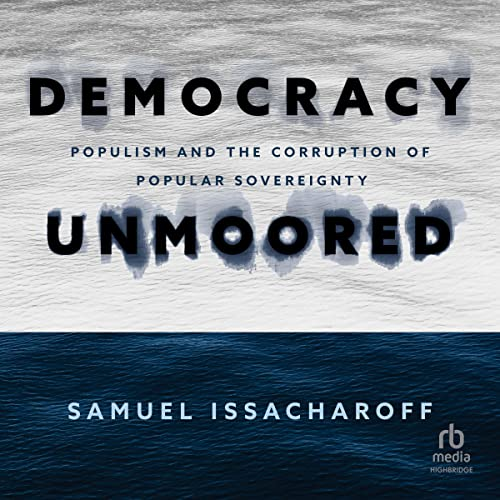
My Hornbook review of Democracy Unmoored is now out at 3:16 AM Magazine here. I had actually expected it to appear at a different venue, but, based on the multitude of revision requests I received (including some pretty strange ones), I got the feeling that the book review editor there vehemently disagreed with my take on the work. So I pulled it.* 

Anyhow, it should be easy to see that I think the book has considerable merits, even if Issacharoff's overall take is somewhat more conservative (or perhaps just less Rah! Rah! Democracy!!) than my own perspective. And I want to add here that interactions of that sort make me even more grateful to Richard Marshall for the pulpit he has generously afforded me at 3:16.

As always, comments are most welcome.


* Of course, it's also quite possible that they just thought my review was crappy. Naturally, I don't love that interpretation, but I'll let my readers decide that for themselves.